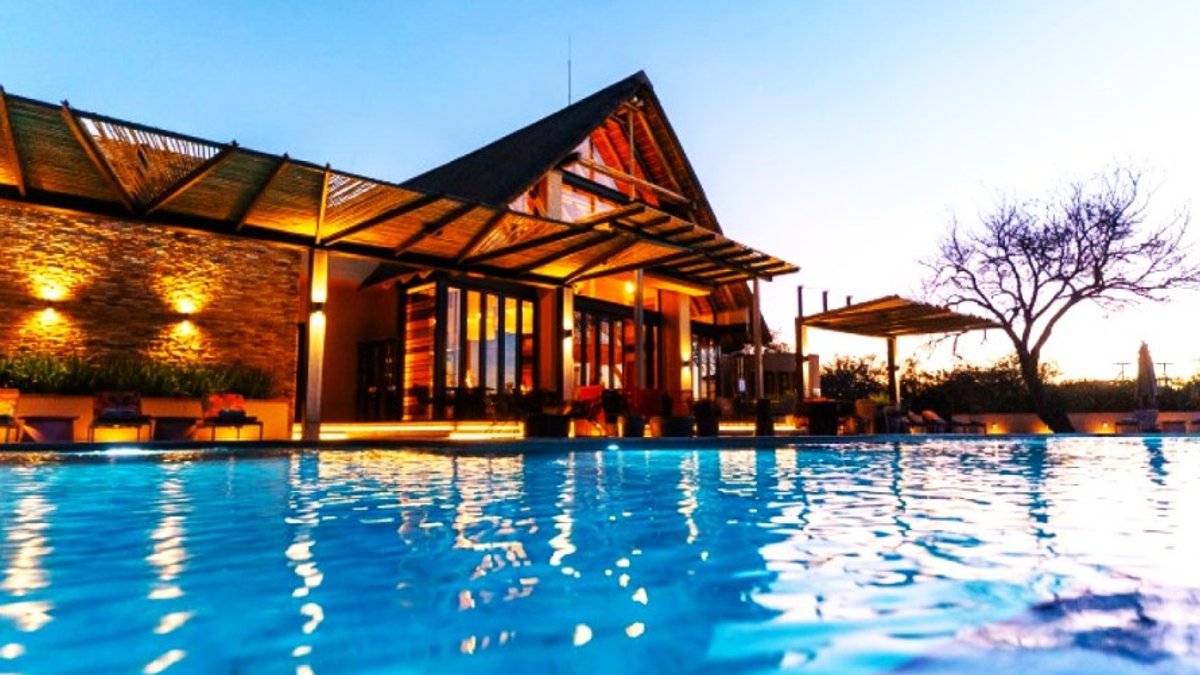
Radisson Safari Hoedspruit has become Africa’s first Verified Net Zero hotel, marking a milestone in sustainable hospitality on the continent. This achievement demonstrates how an existing safari property can reduce its environmental footprint across energy, dining, waste, water, and procurement while maintaining guest comfort.
Powering Operations with Renewables
The 138-room hotel, located near Kruger National Park and Blyde River Canyon, operates on 100 percent renewable energy. On-site solar generation is combined with renewable electricity purchased through guarantees of origin. A solar wheeling agreement, set to begin in 2027, will feed solar power into the national grid, with an equivalent share allocated to the property.
Electrification is prominent in the kitchen, where electric equipment is used for cooking, and in guest rooms, where heat pumps supply hot water. Electric golf carts and three-wheel utility vehicles handle daily transportation, eliminating fossil fuels from routine operations.
Program Context and Broader Goals
Tim Cordon, Chief Operating Officer for the Middle East, Africa, and South East Asia Pacific at Radisson Hotel Group, called the launch of the Verified Net Zero program in Africa an important step toward making lower-carbon hospitality practical across more destinations. He noted that the initiative gives owners and teams across the continent a real-world example of how existing hotels can contribute to the transition toward net zero.
Bringing the program to Africa serves as proof that Verified Net Zero can work in diverse locations, strengthening the group’s understanding of how to apply the approach across different markets as it works toward 100 Verified Net Zero hotels by 2030.
Guests staying at Radisson Safari Hoedspruit, a Verified Net Zero Hotel, experience how comfort, innovation, and sustainability come together in a safari destination. The program follows a reduction-first approach, addressing the hotel’s carbon footprint across Scopes 1 and 2 as defined by the Greenhouse Gas Protocol, alongside its operational and supply chain footprint under Scope 3.
Waste Reduction and Water Conservation
All wastewater is recycled through an on-site treatment plant, and the recovered water is reused daily. Waste separation and partnerships with specialist recycling companies aim to divert 100 percent of waste from landfills. Shodulla Recycling manages plastic, glass, and paper, while Egg Brothers converts food scraps into compost and operates worm-farming initiatives.
In collaboration with the food sustainability platform Klimato, the hotel offers carbon-labeled menus, allowing diners to see the emissions associated with each dish. The culinary team uses this footprint data to review ingredients, develop lower-carbon options, and prioritize sustainable choices in both buffets and à la carte offerings.
Supplier partnerships extend the hotel’s impact. Through the Zanetti Collection, used coffee bags are upcycled into reusable shopping bags by a local sewing project, supporting employment and social programs. Compostable coffee capsules and recyclable tea packaging further minimize waste.
Independent Verification and Future Goals
TÜV Rheinland verifies compliance with the Net Zero Methodology for Hotels, confirming the near-total elimination of Scope 1 and 2 emissions through electrification and renewable power. Scope 3 reductions are assessed across food, waste, laundry, amenities, and procurement chains.